Predictive vs. Generative AI in Markets
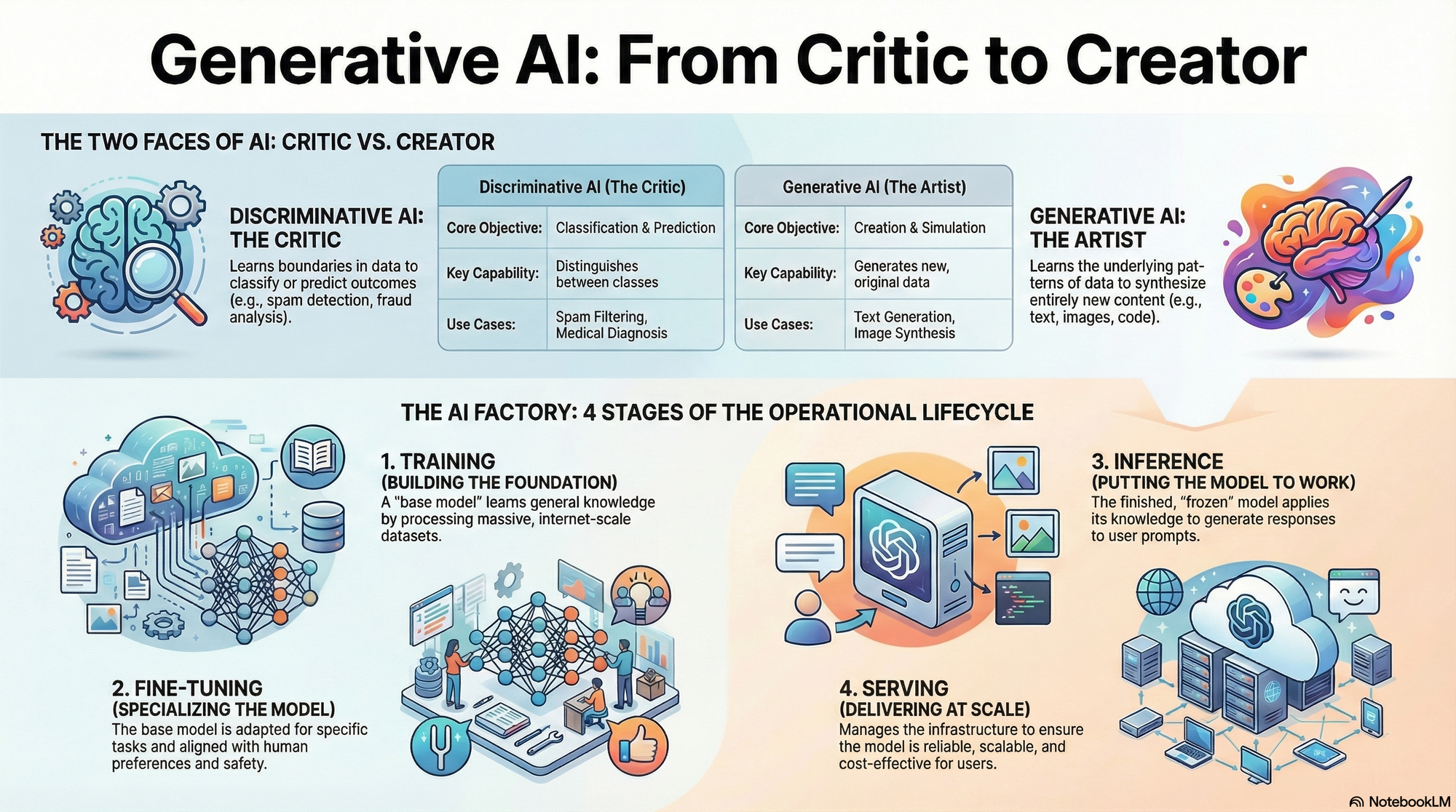
It is easy to confuse generative AI with predictive AI because both rely on large language models and massive datasets. However, they serve fundamentally different purposes in financial markets. Generative AI creates new content—text, code, or images—by learning patterns in training data. Predictive AI analyzes historical data to forecast future events, such as price movements or volatility spikes.
Generative models are trained on vast, unstructured datasets containing millions of examples of human language or visual art. They excel at synthesis and creation. Predictive AI, by contrast, often uses smaller, more targeted datasets focused on specific financial metrics. It looks for statistical relationships in past performance to estimate the likelihood of future outcomes.
For a market analysis guide, the distinction matters because you are not asking the AI to write a news article; you are asking it to predict a trend. Predictive AI powers the forecasting engines behind algorithmic trading and risk management, while generative AI might draft the report on those predictions.
Understanding this separation ensures you select the right infrastructure. You need predictive models for the heavy lifting of data analysis and forecasting, not generative models designed for creative output.
The Data Layers Behind Onchain Predictions
Building a prediction model is like trying to navigate a ship through a storm without a compass. You might have the best engine (your AI algorithm), but if you don’t know where the rocks are, you’re going to crash. In the world of onchain prediction, that "compass" is your data infrastructure. Without reliable, real-time data feeds, even the most sophisticated machine learning models are just guessing.
Oracle Networks: The Bridge to Reality
Onchain smart contracts are isolated by design—they can’t reach out to the internet to fetch weather data, sports scores, or stock prices. This is where oracle networks come in. They act as the bridge between the blockchain and the outside world, bringing offchain data onchain.
Think of an oracle as a trusted courier. If your prediction market needs to know the current price of Bitcoin to settle a bet, it doesn’t trust its own internal logic; it trusts the oracle. But here’s the catch: if that courier brings back fake data, your prediction breaks. That’s why decentralized oracle networks like Chainlink are critical. They aggregate data from multiple independent sources, making it much harder for a single point of failure to corrupt your prediction.
Onchain Data Feeds: The Raw Material
Beyond external events, your model needs to understand the onchain environment itself. This includes transaction volumes, wallet activity, token flows, and gas prices. These onchain data feeds provide the historical and real-time context your AI needs to identify patterns.
For example, if you’re building a prediction model for DeFi yields, you need to know not just the current APY, but how liquidity has moved over the last 24 hours. This raw data is often noisy and unstructured. Your infrastructure needs to clean, normalize, and feed this data into your machine learning pipeline efficiently. Without this layer, your model is flying blind, missing the subtle shifts in market sentiment that often precede major price movements.
The volatility you see in charts like this isn’t just noise—it’s the signal your prediction engine needs to learn from. Understanding the infrastructure that feeds this data is the first step to building a model that doesn’t just react, but anticipates.
Hardware and Software for Prediction Models
Building a prediction model requires more than just an idea; it demands a stack that can handle data ingestion, training, and inference without bottlenecks. The right tools turn raw data into actionable forecasts, while the wrong ones create friction that slows down iteration.
Software Platforms
For teams looking to build custom prediction models without managing the underlying infrastructure, platforms like Microsoft AI Builder provide a structured path. These tools abstract the complexity of machine learning pipelines, allowing you to create prediction models through guided steps rather than writing raw code from scratch Microsoft AI Builder. This approach is ideal for businesses that need reliable forecasting but lack dedicated data science teams.
Hardware Accelerators
Training complex models, especially those involving deep learning, is computationally expensive. Graphics Processing Units (GPUs) are the standard for accelerating these tasks, but the market is volatile. Before investing in hardware, check current market trends to understand pricing and availability shifts.
Recommended Gear
If you are setting up a local development environment or small-scale inference server, you will need specific components. The following tools are selected for their ability to support prediction workflows efficiently.


As an Amazon Associate, we may earn from qualifying purchases.

Strategy for onchain market analysis
AI-generated predictions are powerful signals, but they are not crystal balls. Treating an AI output as a direct buy or sell command is a fast track to liquidation. Instead, view these models as sophisticated risk-assessment tools that help you quantify probability rather than guarantee outcomes. The goal is to integrate AI insights into a structured workflow where human oversight remains the final gatekeeper.
Before trusting a prediction, distinguish between generative AI and predictive AI. Generative models create new content, while predictive models analyze historical data to forecast future events. For market analysis, you need predictive AI—specifically machine learning or deep learning tools trained on price action, volume, and on-chain metrics. MIT Sloan Management Review notes that using the wrong type of AI for prediction tasks leads to hallucinated or irrelevant outputs. Ensure your tool is explicitly trained on time-series financial data, not general text.

AI models often lag behind real-time volatility. Always validate the AI’s directional bias against live market conditions. Use provider-backed widgets to see current price action and volume spikes. If an AI predicts a bullish breakout but the TechnicalChart shows declining volume and resistance at key levels, the signal is likely false. This step prevents you from acting on stale data that the model might have processed before a sudden market shift.
No prediction is 100% accurate. Define your risk parameters before executing any trade based on AI signals. Use position sizing that limits exposure to a small percentage of your portfolio per trade. If the AI predicts a 70% chance of upside, your stop-loss should be set to protect against the 30% downside. Never risk more than you can afford to lose, regardless of how confident the model appears.
-
Set stop-loss based on AI confidence interval
-
Limit position size to 2-5% of portfolio
-
Verify signal against current volume trends
Markets evolve, and so should your strategy. Regularly review the performance of AI predictions against actual outcomes. If a model consistently overestimates volatility, adjust your position sizing accordingly. Continuous monitoring ensures that your AI tools remain aligned with current market regimes, whether they are trending, ranging, or highly volatile.
By treating AI as a co-pilot rather than the autopilot, you maintain control over your financial outcomes. The combination of predictive accuracy, live data verification, and disciplined risk management creates a robust framework for navigating the complexities of onchain markets.
FAQs on AI Prediction Accuracy
Predictive AI relies on statistical algorithms and machine learning to forecast future behavior trends and outcomes based on historical data. Unlike generative AI, which creates new content, predictive models analyze targeted datasets to identify patterns. The best AI for prediction depends on the specific use case, whether it involves financial forecasting, customer churn, or operational efficiency.
Which AI is best for prediction?
There is no single "best" AI for all predictions. The right choice depends on your data structure and the problem you are solving. For tabular data, gradient boosting models like XGBoost often outperform deep learning. For unstructured data like text or images, neural networks are typically more effective. Tools like IBM Watson or specialized MLOps platforms help deploy these models at scale.
What is the 10/20/70 rule for AI?
The 10/20/70 rule describes how time is typically allocated in data science projects. It suggests that only 10% of the effort goes to modeling and algorithm selection, 20% to evaluation and tuning, and 70% to data collection, cleaning, and preparation. This highlights that data quality is the most critical factor in prediction accuracy.
What is the 30% rule for AI?
The 30% rule is a common industry heuristic for data splitting. It refers to reserving 30% of your dataset for testing or validation to ensure the model generalizes well to unseen data. This helps prevent overfitting, where a model performs well on training data but fails in real-world scenarios.
What is a $90,000 AI job?
A "$90,000 AI job" typically refers to roles like Data Scientist, Machine Learning Engineer, or AI Specialist. These positions require strong skills in programming (Python, R), statistics, and cloud infrastructure. Salaries vary by location and experience, with senior roles often exceeding this baseline significantly.
No comments yet. Be the first to share your thoughts!