How predictive AI works
Predictive AI is the engine behind accurate forecasting. It analyzes historical data to identify patterns and forecast future events. This is distinct from generative AI, which creates new content like text or images. While generative AI writes a report, predictive AI tells you which report is most likely to succeed based on past performance.
At its core, predictive AI relies on statistical analysis and machine learning. It examines big data to find trends that humans might miss. The more data provided to the machine learning algorithms, the better the predictions become. This process involves cleaning data, training models, and validating results to ensure accuracy.
Understanding this difference is critical for choosing the right tools. Predictive AI powers agentic AI systems that make decisions, such as predicting stock movements or customer churn. Generative AI assists in drafting the communication around those decisions. For 2026, the most effective tools combine both, but the prediction engine remains the foundation.
Best enterprise prediction platforms
For organizations managing complex data streams, off-the-shelf tools often fall short. Enterprise-grade prediction platforms provide the infrastructure needed to scale machine learning models without building custom pipelines from scratch. These systems handle the heavy lifting of data preparation, model training, and deployment, allowing data teams to focus on interpreting results rather than managing server maintenance.
Microsoft’s AI Builder offers a low-code entry point into predictive modeling for enterprises already invested in the Microsoft 365 ecosystem. By integrating directly with Power Platform, it allows business analysts to create prediction models using historical data from SharePoint, Excel, or Dataverse. The process is streamlined: you select your target column, and the service handles the algorithm selection and training. This approach reduces the dependency on specialized data scientists for routine forecasting tasks, such as predicting customer churn or inventory needs. For detailed implementation steps, Microsoft Learn provides official documentation on creating these models.
IBM Watson Studio caters to data scientists who require more granular control over the machine learning lifecycle. It supports a wide range of open-source frameworks and provides robust tools for model governance and monitoring. This platform is particularly useful for organizations dealing with high-stakes predictions where explainability and regulatory compliance are paramount. By leveraging IBM’s predictive AI capabilities, companies can build models that not only forecast outcomes but also provide clear insights into the factors driving those predictions.
Comparing key features
Choosing the right platform depends on your team's technical expertise and existing tech stack. The table below outlines the core capabilities of these leading enterprise solutions.
| Platform | Primary Integration | Best For | Setup Complexity |
|---|---|---|---|
| Microsoft AI Builder | Power Platform / M365 | Business Analysts | Low |
| IBM Watson Studio | Cloud / On-prem | Data Scientists | High |
| SAS Visual Data Mining | SAS Environment | Enterprise Data Teams | High |
Key considerations for selection
When evaluating these platforms, look beyond the feature list. Consider how well the tool integrates with your current data warehouse and whether it supports the specific types of predictions you need, such as time-series forecasting or classification. Also, verify that the platform offers adequate support for model monitoring and retraining, as predictive accuracy often degrades over time as data patterns shift.
Tools for analysts and developers
If you are building custom prediction models, you need software that handles the heavy lifting of data preparation and algorithm selection. These tools bridge the gap between raw historical data and actionable forecasts, allowing individual professionals to deploy predictive AI without maintaining a massive engineering team.
Predictive AI uses big data analytics and deep learning to examine historical patterns, meaning the more data you provide to the machine learning algorithms, the better the predictions become IBM. However, raw data is rarely clean. The best platforms for analysts and developers focus on reducing the friction between data ingestion and model deployment.
Pecan AI for automated machine learning
Pecan AI is a strong option for developers who want to automate the machine learning pipeline. It allows you to connect your data sources and automatically selects the best algorithms for your specific dataset. This reduces the manual coding required to build and test multiple models, letting you focus on interpreting the results rather than debugging code.
Python libraries for custom control
For developers who need granular control, Python libraries like TensorFlow and PyTorch remain the industry standard. They offer the flexibility to build custom neural networks and fine-tune hyperparameters for specific prediction tasks. While the learning curve is steeper, this approach is necessary when off-the-shelf tools cannot handle the complexity of your data.
Foundational resources for prediction modeling
Building a robust prediction engine often requires a solid understanding of statistical foundations and practical implementation. The following resources provide the necessary background for analysts and developers looking to deepen their expertise in predictive analytics.


As an Amazon Associate, we may earn from qualifying purchases.
Data Requirements and Ethics
Predictive AI is only as good as the data it feeds on. Think of your model like a chef: if you give it spoiled ingredients, no amount of culinary skill will save the dish. In predictive modeling, this means historical data quality, diversity, and volume directly dictate forecast accuracy. IBM notes that while more data generally leads to better predictions, the type of data matters just as much. Biased or narrow datasets will produce biased or narrow results, regardless of how sophisticated the algorithm is.
Ethical considerations are not an afterthought; they are a structural requirement. When training models on historical trends, you risk encoding past inequalities into future predictions. For example, a hiring tool trained on ten years of male-dominated industry data may systematically downweight female candidates. Mitigating these biases requires deliberate data auditing and diverse sampling, ensuring your model sees the full spectrum of reality, not just the loudest signals.
Before you commit to a tool, evaluate its data handling capabilities. Does the platform support transparent data lineage? Can you easily audit for skew? Tools that offer robust data preprocessing and bias detection features will save you from costly corrections later. Remember, a "black box" model might be accurate, but if you cannot explain why it made a prediction, it is likely unusable in high-stakes environments like finance or healthcare.
Ultimately, the best tools for 2026 will be those that prioritize data integrity and ethical transparency alongside raw predictive power. Look for platforms that provide clear documentation on how data is sourced, cleaned, and weighted. This foundation ensures your predictions are not just statistically sound, but also socially responsible and legally compliant.
How to use AI for prediction
Turning raw data into reliable forecasts requires a structured workflow. This process moves from data preparation to model selection, training, and validation.

Start by cleaning and organizing historical data. Remove duplicates, handle missing values, and ensure your dataset is representative of the outcomes you want to predict. High-quality input data is the foundation of any accurate prediction model.

Choose an algorithm that fits your data structure. For structured tabular data, models like XGBoost or Random Forest often perform well. For time-series forecasting, consider LSTM networks or ARIMA. The goal is to match the model’s strengths to your specific prediction task.
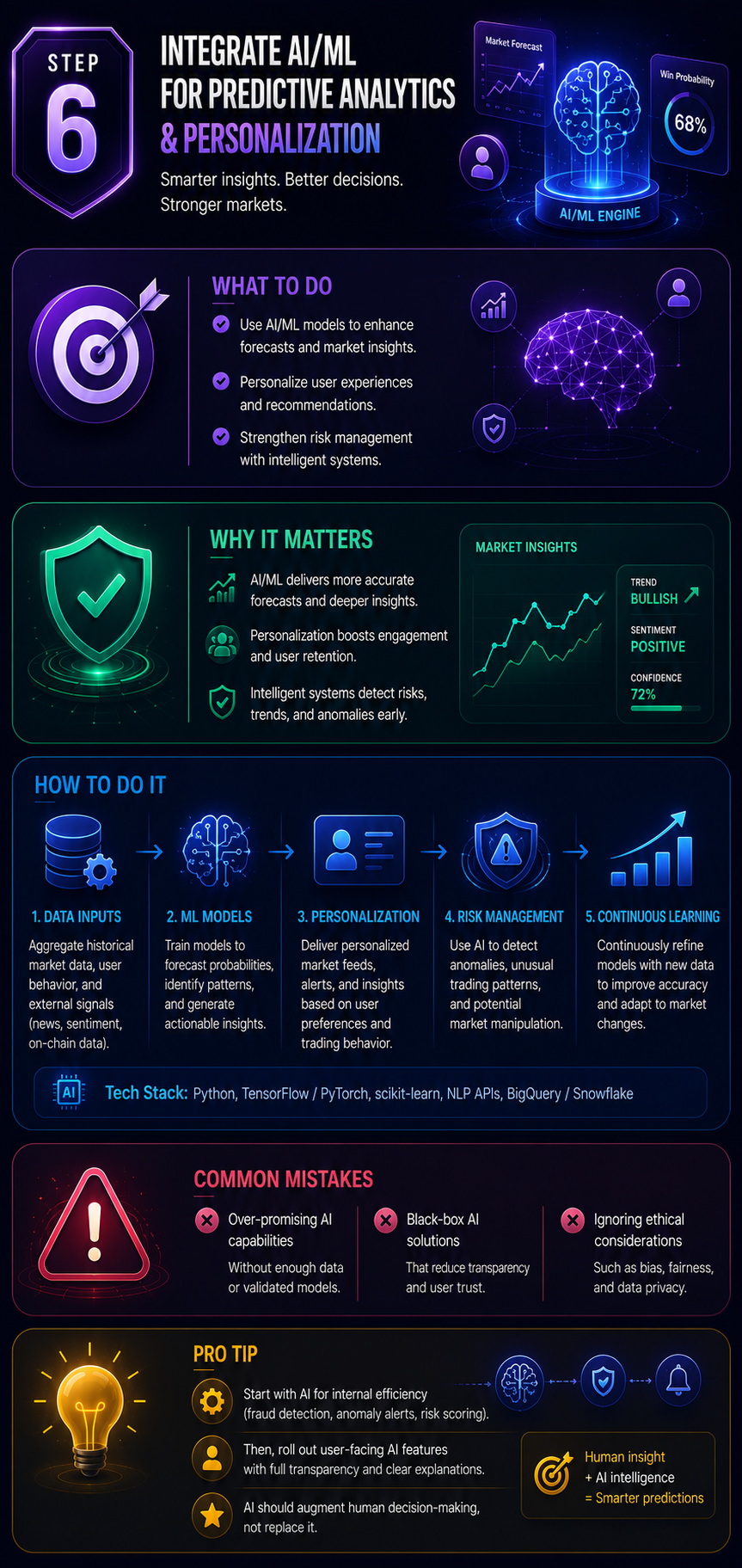
Split your data into training and testing sets. Train the model on the historical data, then validate its performance using unseen test data. Use metrics like accuracy, precision, and recall to evaluate how well the model generalizes to new information.

Once validated, deploy the model into your production environment. Continuously monitor its performance over time, as data patterns can shift. Regularly retrain the model with new data to maintain prediction accuracy and mitigate bias.


As an Amazon Associate, we may earn from qualifying purchases.
For those using Microsoft ecosystems, AI Builder offers a guided path to create prediction models without extensive coding. It automates much of the data preparation and model selection process, making it accessible for business users.
Common questions about predictive AI
Predictive AI uses statistical analysis and machine learning to identify patterns, anticipate behaviors, and forecast upcoming events. By examining historical data, these models reveal trends that help organizations make data-driven decisions rather than relying on intuition.
How does predictive AI differ from generative AI? Generative AI creates new content like text or images, whereas predictive AI analyzes historical data to forecast future outcomes or probabilities. Predictive AI is typically used for decision-making support, such as risk assessment or demand forecasting.
What are the main challenges in implementing predictive AI? Key challenges include data quality, ensuring model explainability, and mitigating bias. Organizations must also manage model drift, where prediction accuracy degrades over time as real-world data patterns change, requiring regular retraining and monitoring.
No comments yet. Be the first to share your thoughts!