Define prediction goals and data sources
Before writing a single line of code, you need to decide what problem the AI is actually solving. Predictive AI is not the same as generative AI. Generative models create new content, like text or images, while predictive models forecast outcomes based on historical data. For infrastructure, you are looking for patterns that signal failure or need, not generating new blueprints.
Start by narrowing your scope to one of three common use cases:
- Damage Detection: Identifying visible cracks, corrosion, or structural anomalies using computer vision on photos or drone footage.
- Maintenance Scheduling: Predicting when a component (like a pump or bridge joint) will fail based on sensor data, allowing for proactive repairs.
- Asset Lifecycle Forecasting: Estimating the remaining useful life of entire assets to inform long-term budgeting and replacement plans.
Once the goal is set, identify the data streams that feed it. Predictive models are only as good as the data they ingest. For maintenance scheduling, you will likely need time-series data from IoT sensors (vibration, temperature, strain). For damage detection, you need high-resolution imagery. Ensure these data sources are reliable, timestamped, and accessible before you begin model training.
Assemble the five-layer AI stack
Predictive infrastructure doesn't run on a single server; it requires a specific hierarchy to function. NVIDIA describes this as a "five-layer cake," where each stratum supports the one above it. You cannot build reliable predictions without securing the foundation first.
This stack is not just theoretical. As noted by industry researchers, the structure of this five-layer model is critical for scaling AI industrially. Each layer must be optimized for the specific demands of the layer above it.
Deploy predictive models for asset management
Integrating AI into your existing infrastructure isn't about replacing current systems; it's about layering intelligence on top of them. The goal is to turn raw sensor data into actionable maintenance schedules before a bridge deck cracks or a pipe bursts. This process requires moving from reactive repairs to predictive interventions.
Follow this sequence to deploy predictive models effectively.
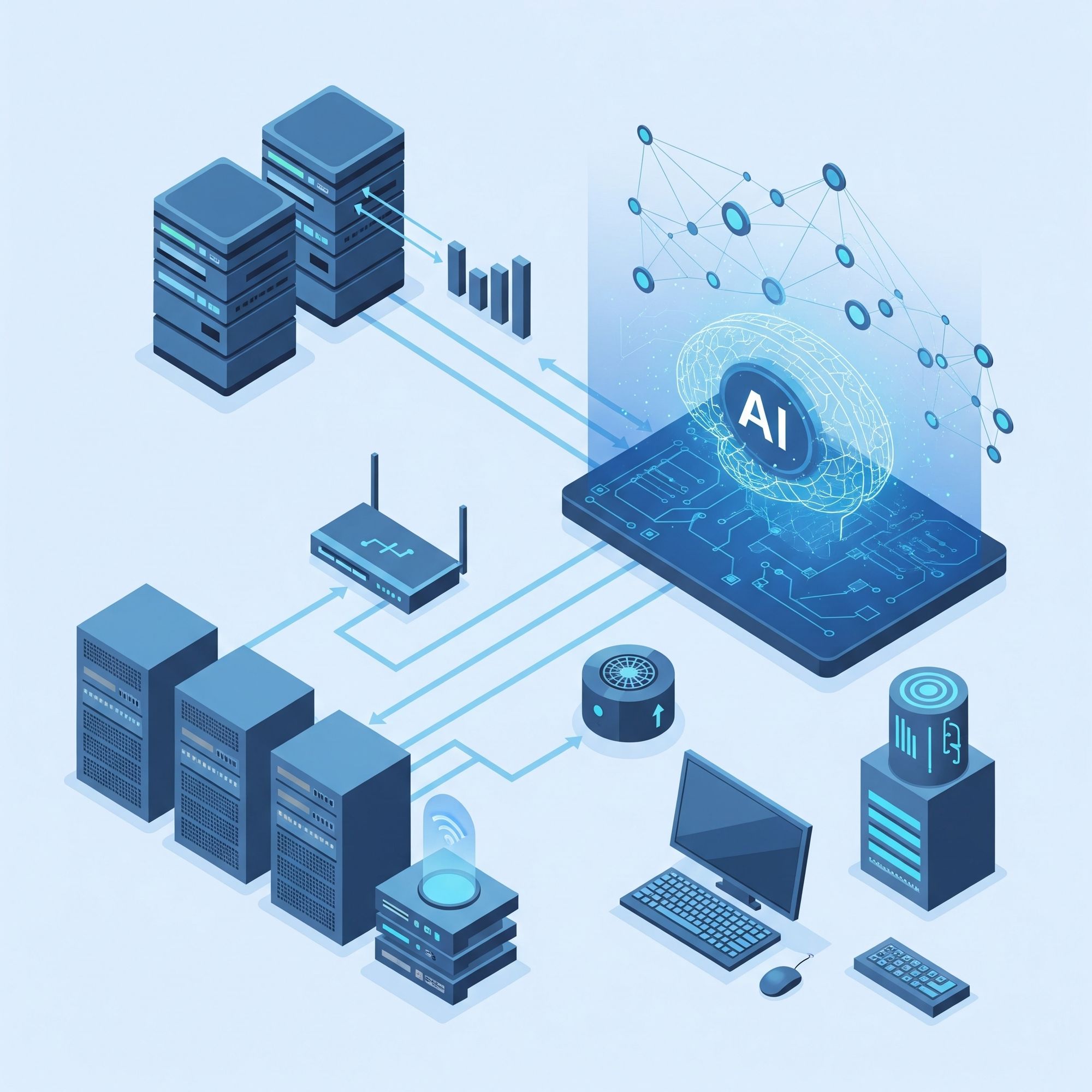
Start by aggregating data from disparate sources: IoT sensors, historical maintenance logs, and environmental feeds. The TriDurLE Project Report highlights that massive field data collection is the foundation of accurate prediction. Ensure your data pipeline can handle real-time ingestion from traffic counters, structural health monitors, and weather stations into a unified data hub.
Feed your aggregated data into machine learning algorithms trained on past infrastructure failures. The Federal Highway Administration (FHWA) notes that AI techniques improve performance by identifying subtle patterns humans miss. Focus on training the model to recognize early warning signs—such as vibration anomalies or corrosion rates—specific to your asset type.
Don't let insights sit in a dashboard. Connect the AI model's output directly to your computerized maintenance management system (CMMS). When the model predicts a 85% probability of failure in a specific segment, it should automatically generate a work order for the field team. This closes the loop between prediction and action.
AI models drift as conditions change. Establish a feedback loop where field reports on actual asset conditions are fed back into the system. Regularly compare predicted outcomes against real-world results to refine the model's accuracy. Continuous validation ensures the infrastructure remains resilient against evolving environmental and usage stresses.
Validate accuracy and manage risks
Before trusting an AI model with critical infrastructure decisions, you need to prove it isn't just guessing. A model that flags every minor crack as a structural failure is useless—it creates noise, not signal. You must verify that the system’s predictions align with physical reality and that false positives don’t trigger unnecessary panic or spending.
Start by establishing a baseline of historical performance. Compare the model’s predictions against known past events. If the model predicted damage to a specific bridge section, did that section actually show signs of wear in maintenance logs? This retrospective analysis helps you calibrate confidence thresholds. For example, researchers have found that AI algorithms can accurately predict moisture damage, allowing engineers to select better materials and plan maintenance more effectively [1]. This level of precision is what you are aiming for.
Next, implement a rigorous false positive management protocol. In high-stakes environments, a false alarm can be as costly as a missed detection. Define clear criteria for what constitutes a "high confidence" alert. If the model is 85% sure there is a leak, but your threshold is 90%, the alert should go to a human reviewer, not an automated work order. This human-in-the-loop step prevents resource waste while maintaining safety.
Finally, monitor the model’s drift over time. Infrastructure changes, weather patterns shift, and new materials are introduced. A model trained on data from five years ago may no longer be accurate today. Set up automated alerts for performance degradation. If the error rate spikes, pause the model and retrain it with recent data. This continuous validation loop ensures your prediction infrastructure remains reliable as the physical world evolves.
-
Compare predictions against historical maintenance logs to establish baseline accuracy.
-
Define confidence thresholds for automated vs. human-reviewed alerts.
-
Set up automated monitoring for model drift and performance degradation.
-
Conduct a pilot test on a non-critical asset before full deployment.
Explore AI infrastructure investment options
Building the prediction engine is only half the work; you also need the compute power to run it. The AI infrastructure stack has solidified into five distinct layers: energy, chips, infrastructure, models, and applications. Investors typically target the chips and infrastructure layers, where demand for high-performance computing is most immediate. NVIDIA outlines this five-layer "cake" as the foundation for industrial AI value creation.
Several companies have emerged as primary beneficiaries of this build-out. CoreWeave (NASDAQ: CRWV), Nebius (NASDAQ: NBIS), and Applied Digital (NASDAQ: APLD) have shown significant growth rates, often exceeding 100%, driven by the urgent need for GPU capacity. These stocks represent direct exposure to the hardware and cloud infrastructure required to train and deploy predictive models.
To support your own infrastructure build, you will need specific hardware and software tools. The following products provide the necessary foundation for testing and deploying prediction models locally or in small-scale edge environments.


As an Amazon Associate, we may earn from qualifying purchases.
Common questions about AI prediction infrastructure
Here are direct answers to the most frequent questions about building and investing in AI-driven infrastructure systems.
These components form the backbone of modern predictive systems, from the physical chips to the final user applications.
No comments yet. Be the first to share your thoughts!